Princesses, Stepsisters and Huntsmen:
300 Years of Women in Fairy Tales
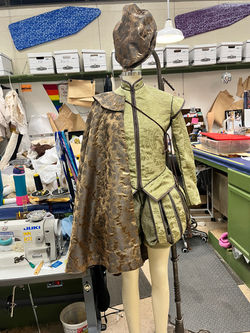
During her time at Penn State, Vanessa created a thesis focusing on costumes for three Grimm fairy tales, spanning three different centuries: The Twelve Huntsmen (16th century), Mother Holle (17th century) and The Goose Girl (18th century). Vanessa worked with a design faculty member to create these designs, then stitched the costumes from scratch.


My Connection to Fairy Tales
I've always had a deep connection to fairy tales. My grandmother used to read them to me when I was very young, but what enchanted me most about visual adaptations of fairy tales were the clothes. I remember watching The Slipper and the Rose, a musical adaptation of Cinderella, when I was a kid and pausing the VHS tape all through the ball scene so I could sketch all the costumes. In a very real sense, the beautiful costumes in that ballroom scene were what led me to pursuing a career in costume production.
THE TWELVE HUNTSMEN: 16TH CENTURY
One of the reasons I chose to make this a 16th-century costume was that during this time, women were barred from performing, so men would often cross-dress as women to play female parts. I thought it would be funny to subvert this and create a costume where a woman is dressed as a man. This was an era where the male clothing silhouette was much more extravagant and what we in the modern era would see as more feminine, so creating a huntsman costume for Kayla, my fit model, presented some interesting challenges. This is a character that other characters recognize as male, but which the audience can see is female, so as a costumer I need to strike a balance between a costume that fits well enough not to look boxy, but isn’t so form-fitting that it’s obvious the actor is female. I also had to take my model’s proportions into consideration to make the costume look right for her dimensions. We are often asked to fit different body shapes and genders, but sometimes we’re also asked to fit clothes in an unorthodox way, such as hiding a character’s gender to one group while revealing it to another. I also had to strike a balance between the historical and the theatrical, as some very historically accurate costumes do not look good on stage, the silhouettes are too odd for modern audiences’ tastes, or details of the costume don’t support the story we want to tell.
 |  |  |  |  |  |
|---|---|---|---|---|---|
 |  |  |  |  |  |
 |  |  |  |  |  |
 |  |  |  |
MOTHER HOLLE: 17TH CENTURY
I chose this story because I wanted to focus on a Cinderella-like character, and I also wanted to focus on the 17th century because we aren’t often asked to create costumes from this era, so I thought it would provide a good challenge for a thesis monograph. I wanted the opportunity to create a fantastical costume with the structure and layers that were common to this era. I also wanted to create a costume with strong visual impact for the audience, and the moment where the stepdaughter is showered in gold provided plenty of visual impact. I wanted to incorporate elements of the fairy tale into the costume, and I decided embroidery would probably be the best choice. I worked with Connor, a local artist, to create the design; I sketched out the basic symbols, Connor rendered the design and we sent it to a digitizer so I could embroider it on my machine. I tried to mirror the swirls in the fabric with the embroidered elements.
 |  |  |  |  |  |
|---|---|---|---|---|---|
 |  |  |  |  |  |
 |  |  |  |  |  |
 |  |  |
THE GOOSE GIRL: 18TH CENTURY
I chose The Goose Girl because as costumers we are often asked to create costumes for working-class people, and I wanted to explore the costuming of a princess dressed in rags. Of the three time periods I chose to focus on, the 18th century has the most extant examples of working-class clothing. The designs that Richard and I worked on together were researched online, and one of the most fascinating pieces was the bodice. To avoid looking flat on stage, even everyday costumes need to have interesting patterns or textures to come alive and emphasize shape and detail. The fabric I chose for the bodice was purchased secondhand, and the speckles of color in the fabric give it definition and visual interest.
 |  |  |  |  |  |
|---|---|---|---|---|---|
 |  |  |  |  |  |
 |  |  |  |  |  |